

CM at Risk or Design-Build? How to Choose the Right Delivery Method for Your Project
One of the most consequential decisions an owner makes before a single drawing is complete is not about materials, budget, or even architect selection. It is the decision about how the project will be delivered.
The delivery method you choose determines who carries risk, when cost certainty arrives, how early a contractor’s expertise enters the process, and how the relationships between owner, designer, and builder will function for the life of the project. It shapes the entire experience, not just the outcome.
At Vannoy Construction, we have delivered major commercial projects through Construction Manager at Risk (CMAR), Design-Build, and traditional Design-Bid-Build. We have 74 years of perspective on what each method produces and when each is the right fit. Both CMAR and Design-Build offer significant advantages over the traditional path and the right choice between them comes down to what your project requires.
The Baseline: Why Design-Bid-Build Leaves So Much on the Table
Before comparing CMAR and Design-Build, it helps to understand both options are an improvement over the traditional Design-Bid-Build process.
In Design-Bid-Build, the owner engages an architect to develop construction documents to near or full completion. Once the documents are ready, the project goes to a competitive bid. A general contractor is selected and construction begins.
This model made sense in an era when projects were simpler, schedules were longer, and the lowest price was the primary objective. For many owners today, it creates structural challenges that are difficult to manage:
- No contractor input during design. The contractor who will actually build the project has no voice during the phase when cost, schedule, and constructability decisions are being made. Coordination gaps, specification issues, and value opportunities are discovered after the documents are complete and when they are expensive to address.
- Late budget certainty. Owners carry budget risk through the entire design phase. The first real cost signal often comes at bid opening and if bids come in over budget, the owner faces the difficult choice of redesigning, reducing scope, or finding additional funds.
- Adversarial dynamics. When a contractor wins on the lowest number, the pressure to recover margin can shape how the project is managed. Change orders become a mechanism, not an exception. The relationship can become transactional at exactly the moments when collaboration matters most.
- Slowest path to delivery. When design is fully completed before construction begins this is a long overall schedule. For owners with time-sensitive occupancy needs, this is a real cost.
Neither CMAR nor Design-Build is perfect for every project. But both are structured to address these fundamental limitations.
Construction Manager at Risk: Collaboration from Day One
In a Construction Manager at Risk arrangement, the owner engages a general contractor early and the contractor participates in the design process as a collaborative partner. Preconstruction services include budget development, constructability review, schedule analysis, systems input, and subcontractor market evaluation.
At a defined point, typically when design reaches 60 to 90 percent completion, the contractor provides a Guaranteed Maximum Price (GMP). The GMP establishes a cost ceiling the contractor is contractually committed to.
The owner retains a direct contract with the design team throughout, maintaining full engagement in design decisions.
What CMAR Does Best
- Brings cost intelligence into the design process early. When a contractor is at the table as documents evolve, budget implications of design decisions are visible in real time. Scope can be refined, systems evaluated, and value opportunities identified before they become change orders.
- Provides maximum owner involvement in design. Because the owner retains a direct contract with the architect, the owner’s relationship with the design team is unchanged. Design intent is protected. Owners who have strong aesthetic or program requirements often find CMAR gives them the collaboration they need without sacrificing design control.
- Creates genuine cost transparency. CMAR is typically an open-book process. Owners can see actual subcontractor bids, verify contingency use, and confirm that the GMP reflects real market conditions. For municipalities, healthcare systems, educational institutions with public accountability this transparency is often essential.
- Supports complex, phased, or uncertain programs. Projects where the scope may evolve, phasing is required, or program requirements are still being refined are well suited to CMAR. The structure accommodates change more gracefully than a fixed lump-sum contract.
- Ideal for first-time or infrequent builders. Owners who are building for the first time or who build infrequently and want full transparency into the process benefit from the collaborative structure of CMAR. The contractor also serves as an advisor.
Where CMAR Requires More from the Owner
CMAR works best when the owner is actively engaged throughout preconstruction. The collaborative process requires time, decision-making capacity, and willingness to participate in design reviews and cost discussions. Owners who want to hand the project off and receive a finished product may find this level of involvement more than they anticipated.
The GMP also does not arrive until design is substantially complete, which means the owner carries budget risk through the design phase. However, substantially less than in Design-Bid-Build.
Design-Build: Speed, Accountability, and a Single Point of Responsibility
In Design-Build, the owner engages a single entity, the design-builder, who is responsible for both design and construction. At Vannoy, that means our team leads or manages the integrated effort, coordinating design and construction under one contractual roof from project inception through delivery.
Design-Build typically produces a lump-sum price earlier in the process, often before design is fully developed, based on an agreed-upon program and performance criteria. The contractor assumes the risk of delivering the project to those requirements within the agreed price.
What Design-Build Does Best
- Fastest path from concept to occupancy. Because design and construction are managed by a single team, phases can overlap. Foundation work can begin while structural drawings are being completed. For owners where time to occupancy has direct revenue or operational implications, the schedule advantage of Design-Build is substantial.
- Single point of accountability. In Design-Build, there is one entity responsible for both design and construction. Coordination issues, design gaps, and constructability problems are the design-builder’s responsibility to resolve. This clarity reduces administrative burden on the owner and eliminates the finger-pointing dynamic that can emerge when design and construction teams are separate.
- Earlier cost certainty. Because the contractor is aligned with design from the beginning, cost certainty often arrives earlier in the process. For owners who need to secure financing, obtain board approval, or demonstrate project feasibility early, this is a meaningful advantage.
- Natural incentive for innovation and efficiency. When the same team is responsible for design and construction costs, there is a built-in incentive to develop efficient solutions. Systems integration, material selection, and sequencing are optimized by a team that has to build what it designs.
- Well suited to program-driven or facility-type projects. Industrial facilities, distribution centers, manufacturing plants, and program-driven projects where performance specifications are clear are classic applications for Design-Build.
Where Design-Build Requires More from the Owner Upfront
Design-Build works best when the owner’s program and performance requirements are well defined before the contract is established. Changes after a lump-sum is agreed upon can be expensive, because scope adjustments affect a fixed-price contract. Owners who anticipate program evolution or who have complex, customized design requirements may find CMAR a better fit.
Because the architect in a Design-Build arrangement works for the contractor rather than the owner, owners who want independent design advocacy should weigh that dynamic carefully.
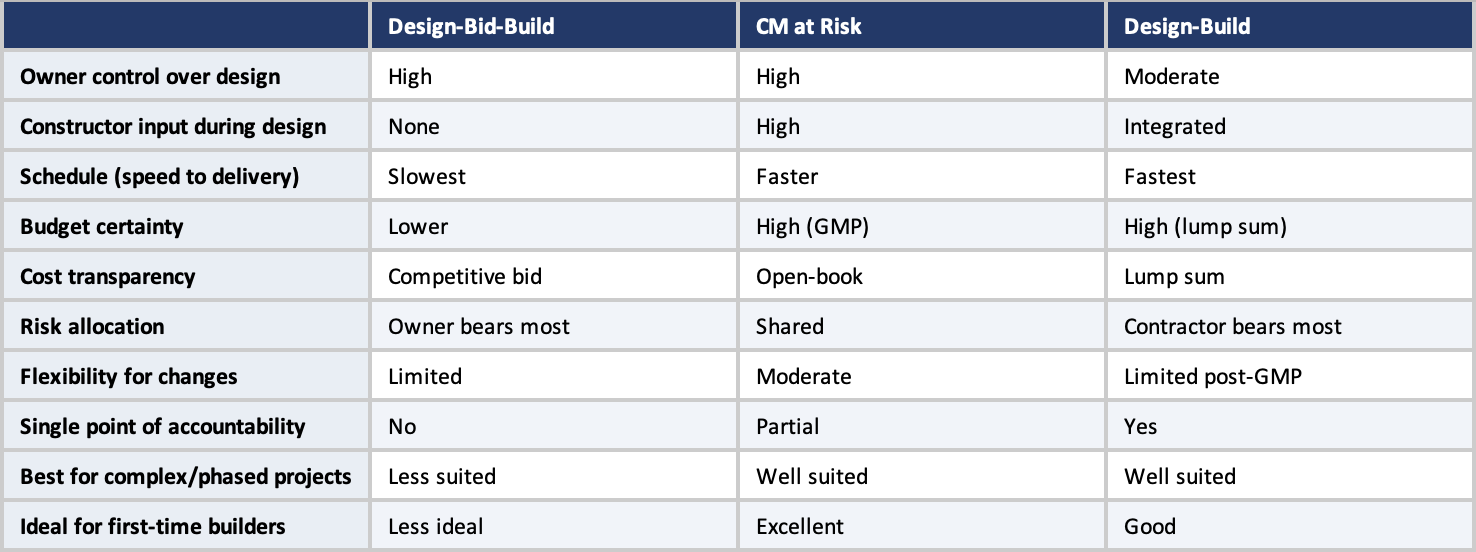
Side-by-Side: Design-Bid-Build, CM at Risk, and Design-Build The table below provides a practical comparison across the dimensions that matter most to owners evaluating delivery methods.
How Vannoy Approaches the Delivery Method Conversation
Both CMAR and Design-Build are tools. The right one depends on what the owner is trying to accomplish and what the project requires.
Here are the questions we work through together:
How well-defined is your program?
Is the scope still evolving? If you’re still making decisions about program elements, phasing, or design direction then CMAR gives you the flexibility to move through design with a contractor at your side, refining cost as the scope clarifies. If your program is well defined and you are ready to establish a fixed price against clear performance criteria, Design-Build accelerates delivery and locks in accountability.
How important is design control and independence?
If you have specific design intent, are working with an architect you have already selected, or are building a facility where aesthetic distinctiveness is a priority, CMAR preserves your direct relationship with the design team. If design is a means to a performance end—and you’re more focused on what the facility does than on how it looks—Design-Build’s integrated approach is often the better fit.
How important is schedule?
If time to delivery is your most critical constraint—if a delayed opening has direct operational or financial consequences—Design-Build’s ability to fast-track and compress the overall schedule is a genuine advantage. CMAR can also accelerate delivery compared to Design-Bid-Build, but it typically requires design to reach GMP before major construction begins.
What level of transparency do you need?
For publicly funded projects, institutional owners with board oversight, or first-time builders who want full visibility into how their money is being spent, CMAR’s open-book structure provides a level of transparency that Design-Build’s lump-sum model does not. If cost certainty and single-source accountability matter more than line-item visibility, Design-Build may be the stronger fit.
How much risk are you prepared to carry vs. transfer?
In Design-Build, the contractor assumes substantially more project risk in exchange for control over design and construction decisions. In CMAR, risk is more explicitly shared—the GMP provides a ceiling, but the owner retains more engagement in the decisions that affect it. Neither model is objectively better; the right answer depends on your organization’s appetite for involvement and your confidence in your contractor.
The Right Delivery Method Starts with the Right Conversation
If you are beginning to plan a commercial project and are trying to determine which delivery method is right for your needs, Vannoy’s preconstruction team is ready to help you think it through—without obligation and without a predetermined answer.
We have delivered CMAR projects for healthcare systems, educational institutions, municipal clients, and corporate campuses. We have delivered Design-Build projects for industrial operators, mission-critical facilities, and time-sensitive program expansions. In each case, the method was chosen because it was right for the project—not because it was convenient for us.
That is the Vannoy commitment. Visit jrvannoy.com to explore our project portfolio or reach out to our team to begin a conversation.